

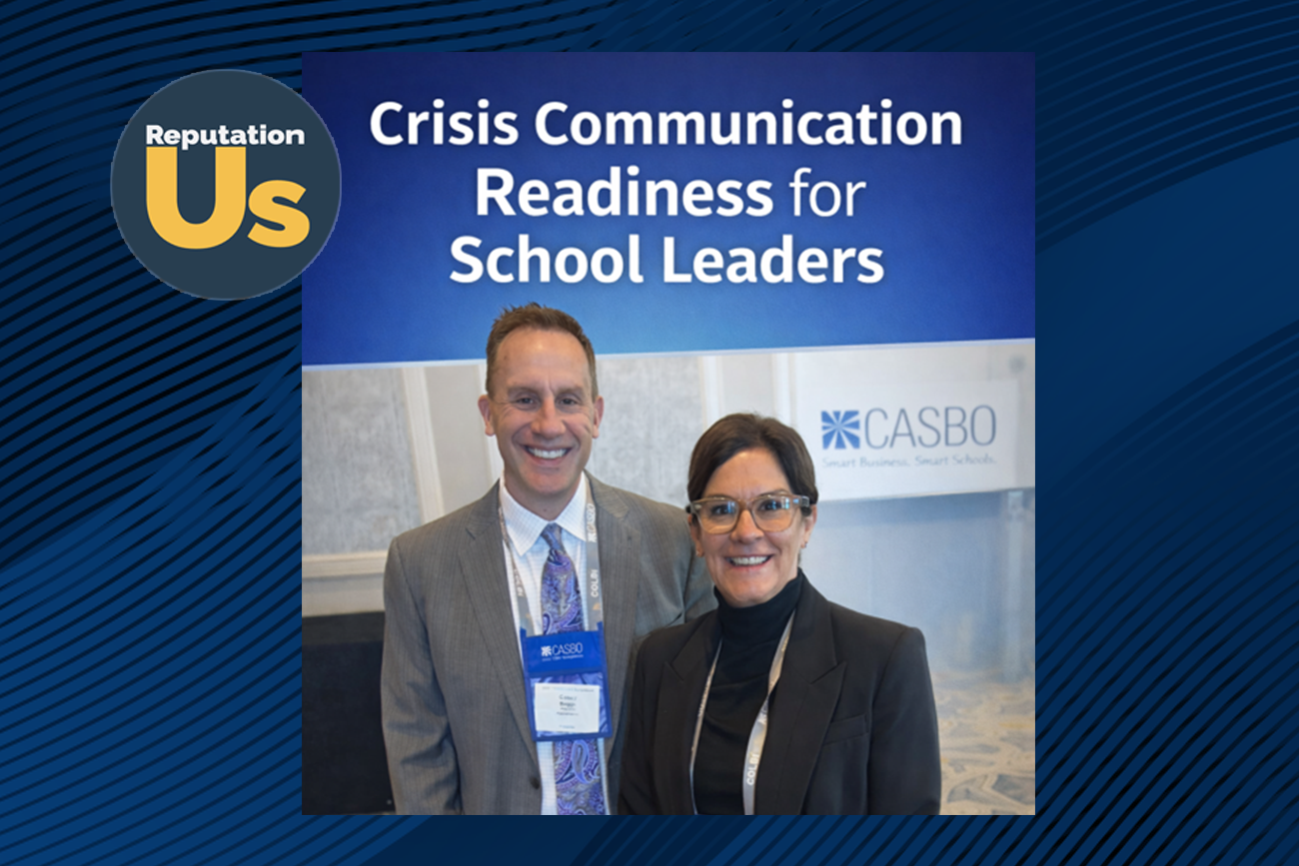
*Article originally appeared on the California School Business Officials (CASBO) website.
Despite the growing frequency of crises impacting school districts, many are still under-prepared from a communications standpoint. While most districts have emergency response plans, according to the National School Public Relations Association (NSPRA) only 57% of school communication leaders today list crisis communications as a core priority of their role (down from 69% in 2020). This alarming gap suggests that a significant portion of districts are not sufficiently focused on communication readiness before, during, and after a crisis.
Moreover, independent safety research indicates noticeable gaps in crisis communication reach and effectiveness, with nearly one-quarter of districts reporting challenges in effectively reaching staff and more than one-quarter reporting difficulties communicating with students and families during emergencies.
These data points reveal that having a written plan is not the same as being ready to execute high-stakes communication under pressure. Specifically, training, role clarity, and leadership engagement remain critical weaknesses in many districts’ crisis response capabilities.
Crisis: An Operational Certainty
For today’s school districts, crisis is no longer a distant possibility, it is an operational certainty. From cyberattacks and AI-related disruptions to natural disasters, HR issues, funding controversies, and campus safety incidents, districts are navigating a growing list of high-impact risks under constant public scrutiny. As the saying goes, “If it bleeds, it leads.” Media headlines move fast, misinformation spreads faster, and silence is often interpreted as incompetence or indifference.
For Chief Business Officials (CBOs), crisis communication is not just a communications department function, it is a leadership imperative. When a crisis hits, CBOs are central to financial decision-making, operational continuity, and public trust. The districts that weather crises best are those that prepare early, communicate clearly, and lead with confidence and control.
Defining a “Crisis” in a School District Context
A crisis is any event that threatens student or staff safety, district operations, finances, or reputation, and demands immediate attention. Recent examples illustrate the range: school safety concerns following gun incidents, funding debates distorted by inflation and expiring federal aid, immigration enforcement near campuses, executive misconduct, or ransomware attacks that shut down critical systems. What unites these events is not their cause, but their consequences: uncertainty, fear, and intense stakeholder demand for information.
The CBO’s Role: Calm at the Center of the Storm
During a crisis, the Chief Business Official plays a critical stabilizing role. CBOs help ensure continuity of operations, coordinate with leadership and external agencies, assess financial impacts, and support transparent decision making. Equally important, they help shape messaging that balances accuracy, empathy, and fiscal responsibility. In moments of chaos, stakeholders look to district leadership for calm, credible guidance, and the CBO is often a key voice behind that confidence.
Seven Actions for Effective Crisis Communication
1. Develop and Maintain a Comprehensive Crisis Communication Plan (Before)
Districts should maintain an all-hazards communication plan developed collaboratively with leadership, emergency services, key stakeholders and local government. The plan should define spokesperson roles, approval processes, and communication protocols, while clearly identifying key audiences such as staff, parents, students, board members, vendors, and community partners.
2. Build and Maintain Contact Lists and Communication Systems (Before)
Up-to-date contact databases are essential. Emergency notification systems (e.g., phone, text, email, websites, and social platforms) should be tested regularly. Knowing where and how to reach people matters just as much as what you say.
3. Train Staff and Conduct Communication Drills (Before)
Training department heads on confidentiality and message consistency reduces risk. Simulated crisis exercises, much like athletic team practices, help leaders build muscle memory so they can perform under pressure when it matters most.
4. Coordinate Messages with Leadership and Emergency Agencies (During)
Alignment is critical. Public statements must be consistent across the superintendent, board leadership, communications staff, and emergency agencies. Districts should maintain one unified, trusted source of information.
According to Casey Boggs, reputation expert and Chief Reputation Officer at ReputationUS, districts should consider the following model:
“UP. INSIDE. OUT” Communications
UP: Board, superintendent, principals
INSIDE: Staff, teachers, parents
OUT: Media, public, social platforms
Boggs, a presenter at the recent CASBO CBO Symposium, emphasizes that this model ensures clear timing of information releases and consistency across audiences.
5. Communicate Early, Accurately, and Transparently (During)
Speed matters, but accuracy matters more. Share verified information as soon as possible to prevent misinformation. Acknowledge what is known, what is still being assessed, and when updates will follow. A calm, empathetic tone builds credibility even when answers are incomplete. It is OK to say some information may not be available yet, or is still being processed.
6. Provide Ongoing Updates and Reassurance (After)
Recovery does not end when headlines fade. Districts should communicate timelines, financial impacts, and next steps clearly, while expressing empathy and gratitude to staff, families, and partners.
7. Review and Improve Communication Practices (After)
Every crisis offers lessons. Post-crisis debriefs allow districts to evaluate what worked, identify gaps, and update plans, contact lists, and training materials accordingly. Additionally, monitoring and archiving communications and information is key.
From Risk to Readiness
Boggs adds that written in Chinese, the word “crisis” is often described as combining the concepts of danger and opportunity. For school business leaders, that opportunity lies in preparation. Districts that invest in crisis communication planning before an incident occurs are better positioned to protect trust, stabilize operations, and lead their communities through uncertainty.
In crisis, perfection is not the goal. Clarity, confidence, and control are. And when leaders keep going, even through the hardest moments, communities notice.