

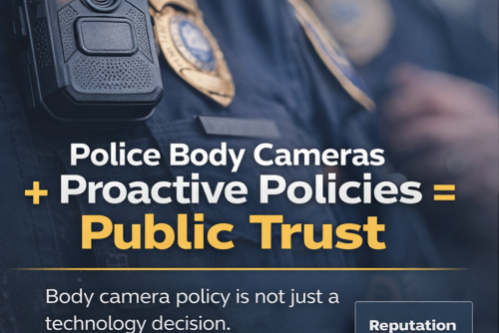
Across the United States, body-worn cameras have quickly become a standard tool in modern policing, but technology alone doesn’t build trust. Policy and communication do.
Today, according the R Street Institute, nearly 80% of large U.S. law enforcement agencies regularly use body-worn cameras, and about 77% of local governments report their police departments utilize them, reflecting a dramatic rise in adoption over the past decade.
At the same time, according to Cato Institute, public expectations for transparency have never been higher. Cato’s survey shows that about 89% of Americans support requiring officers to wear body cameras, one of the rare issues with broad bipartisan agreement.
Yet cameras alone do not create trust. The real reputation impact comes from how police agencies communicate policies before, during, and after implementation or when controversy inevitably arises.
For police leaders, body camera policy is not just a technology decision. It is a reputation strategy.
Transparency Begins Before the First Recording
The most effective police agencies understand that public trust is shaped before cameras ever capture an incident.
A proactive body-camera rollout usually includes three critical communication steps:
1. Clear public explanation of the policy
Communities want to know:
-
When cameras must be activated
-
When they may be turned off
-
How footage is stored
-
When footage will be released
Without clarity, rumors fill the gap.
2. Expectations for officers and supervisors
Formal policies are essential. In fact, the National Institute of Justice claims that about 86% of police agencies that adopt body cameras establish formal operational policies governing their use.
3. Early community engagement
Town halls, website explainers, and FAQs about privacy, footage access, and accountability help communities understand that the cameras are meant to protect both the public and the officer.
This proactive transparency creates what reputation professionals call “trust reserves.” When a critical incident occurs, agencies that have already explained their policies start the conversation from a position of credibility.
When Policy Is Clear, Reputation Is Stronger
Several large agencies have demonstrated how proactive communication strengthens public confidence.
New York City Police Department
The New York City Police Department operates the largest body-camera program in the United States, equipping more than 24,000 officers (Wow, right?) with cameras as part of a phased rollout accompanied by public documentation of policies and procedures.
Key communication practices included:
-
Publishing the full body-camera policy online
-
Explaining rollout phases and officer training
-
Clarifying when cameras must be activated
Providing this level of transparency helps residents understand how footage is collected and used, reducing speculation when incidents occur.
Norwalk Police Department: Technology & Communication
In 2026, the Norwalk Police Department announced a pilot program adding real-time language translation capabilities to body cameras, designed to help officers communicate with residents who speak different languages.
The department publicly explained:
-
Why the technology was introduced
-
How it would improve interactions with residents
-
The cost and evaluation timeline
This type of proactive explanation signals that the agency is investing in transparency and community service, not just surveillance.
The Reputation Risks of Silence
When agencies fail to communicate clearly about body-camera policies, the reputational consequences can be significant.
Recent national coverage shows how body-camera footage can quickly become public and viral; sometimes edited, monetized, or taken out of context on social media platforms.
Without clear policy communication, agencies can face:
-
Allegations of selective release of footage
-
Criticism about privacy violations
-
Questions about whether cameras were activated
In short, the absence of communication invites speculation—and speculation damages trust.
The Three Phases of Body Camera Communication
For police chiefs and sheriffs, communication should mirror the lifecycle of the program.
1. Before Implementation
-
Publish the policy publicly
-
Explain activation requirements
-
Address privacy concerns
-
Engage community leaders and media
2. During Incidents
-
Reference the policy consistently
-
Explain when footage can legally be released
-
Provide timelines for review and disclosure
3. After Incidents
-
Release footage responsibly and transparently
-
Provide context alongside video
-
Communicate investigative processes clearly
Agencies that follow these steps maintain credibility even when incidents become controversial.
Cameras Record Actions. Communication Shapes Reputation.
Body cameras capture interactions, but they don’t interpret them. That responsibility belongs to leadership.
For law enforcement agencies, the lesson is simple:
Transparency cannot start during a crisis.
Departments that proactively communicate body-camera policies—how they work, why they exist, and how the public can expect them to be used—build trust long before a controversial incident occurs.
In reputation management, preparation always beats reaction.
Because in the modern media environment, every recorded interaction has the potential to become a national conversation.
The question for police leaders is not whether body-camera footage will be scrutinized.
The question is whether the agency has already built the trust needed to withstand that scrutiny.