
In today’s environment, police agencies operate under an unprecedented level of public scrutiny. Every interaction, incident, and decision can be recorded, shared, and debated within minutes. In this reality, reputation is no longer shaped only by crime statistics or enforcement success. It is shaped by how police agencies communicate, respond, engage, and demonstrate accountability.
For police leaders, reputation is not simply a public relations issue, it is a strategic leadership responsibility that directly impacts recruiting, community trust, officer morale, and operational effectiveness.
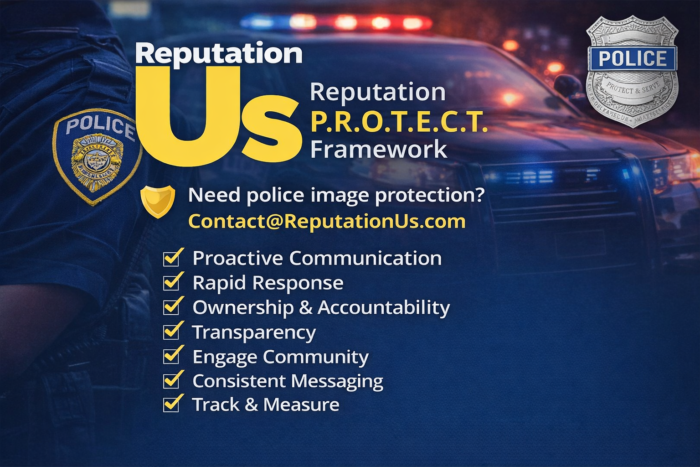
Recognizing this challenge, ReputationUs developed the Reputation P.R.O.T.E.C.T. Framework, a practical model designed to help police agencies proactively manage reputation risk while strengthening public confidence.
Why Reputation Matters More Than Ever in Policing
A police agency’s reputation influences nearly every aspect of its effectiveness:
-
Community cooperation during investigations
-
Public willingness to report crime
-
Recruiting and retention of officers
-
Relationships with elected officials and community leaders
-
Media coverage and public narratives
When trust is strong, communities and police work together. When trust erodes, even routine policing can become difficult.
The Reputation P.R.O.T.E.C.T. Framework provides a structured way for agencies to build and maintain that trust.
The P.R.O.T.E.C.T. Framework
The framework outlines seven key pillars that police leaders can implement to strengthen reputation and improve public confidence.
P — Proactive Communication
Effective agencies communicate regularly, not just during crises. Proactive communication includes sharing positive community stories, explaining policies, providing updates on crime trends, and engaging with residents before issues escalate.
When agencies communicate early and often, they shape understanding rather than react to misinformation.
R — Rapid Response
In the digital age, narratives develop within minutes. Police departments must be prepared to respond quickly and clearly during critical incidents.
Rapid response protocols ensure that accurate information reaches the public before speculation or misinformation fills the void.
O — Ownership & Accountability
Trust grows when leaders demonstrate responsibility. Agencies that acknowledge mistakes, communicate corrective actions, and hold themselves accountable strengthen their credibility with the public.
Ownership does not weaken leadership, but rather reinforces legitimacy.
T — Transparency
Transparency is essential to modern policing. Publishing policies, explaining investigative processes, and sharing data on complaints, use-of-force incidents, and outcomes helps the public understand how decisions are made.
When agencies are transparent, speculation decreases and confidence grows.
E — Engage Community
Strong relationships between police and residents are the foundation of public safety. Community engagement initiatives—from neighborhood meetings to youth outreach programs—help officers build relationships beyond enforcement.
These relationships often become the strongest protection for a department’s reputation during difficult moments.
C — Consistent Messaging
Consistency builds credibility. Police agencies must ensure that communication from leadership, public information officers, and officers themselves aligns with the agency’s mission and values.
A unified voice helps prevent confusion and reinforces professionalism.
T — Track & Measure
Reputation can—and should—be measured. Agencies can track public sentiment, media coverage, community feedback, internal morale, and recruitment trends to understand how their reputation is evolving.
By measuring these indicators, leaders can make informed decisions to strengthen public trust.
A Framework Built for Today’s Policing Environment
The Reputation P.R.O.T.E.C.T. Framework is not simply a communications strategy, additionally it’s a leadership approach that integrates culture, communication, and accountability.
Police agencies that implement these principles position themselves to:
-
Strengthen community trust
-
Improve recruiting and retention
-
Navigate crises more effectively
-
Demonstrate professionalism and accountability
-
Build long-term legitimacy with the public
In an era where public perception can shift rapidly, agencies that proactively protect their reputation are better equipped to fulfill their mission.
Protecting the Good Name of Policing
Police officers serve communities with dedication and courage every day. Ensuring that the public understands that service, and maintaining the trust necessary to perform the job effectively—requires intentional leadership.
The Reputation P.R.O.T.E.C.T. Framework provides a roadmap for police agencies to protect their reputation, strengthen relationships, and reinforce the confidence of the communities they serve.
To learn more about the Reputation P.R.O.T.E.C.T. Framework and how it applies to your unique situation at your agency, Contact@ReputationUs and schedule a meeting HERE.