A recent LinkedIn post from Gina Bonar of Five Whys Marketing made an important point that more organizations need to understand: public relations is becoming one of the most important drivers of visibility in the AI era.
Gina’s right.
For years, organizations viewed PR primarily as media relations, crisis communications, or brand awareness. Those disciplines still matter. But in today’s AI-driven environment, public relations is increasingly becoming a strategic business asset tied directly to discoverability, credibility, and trust.
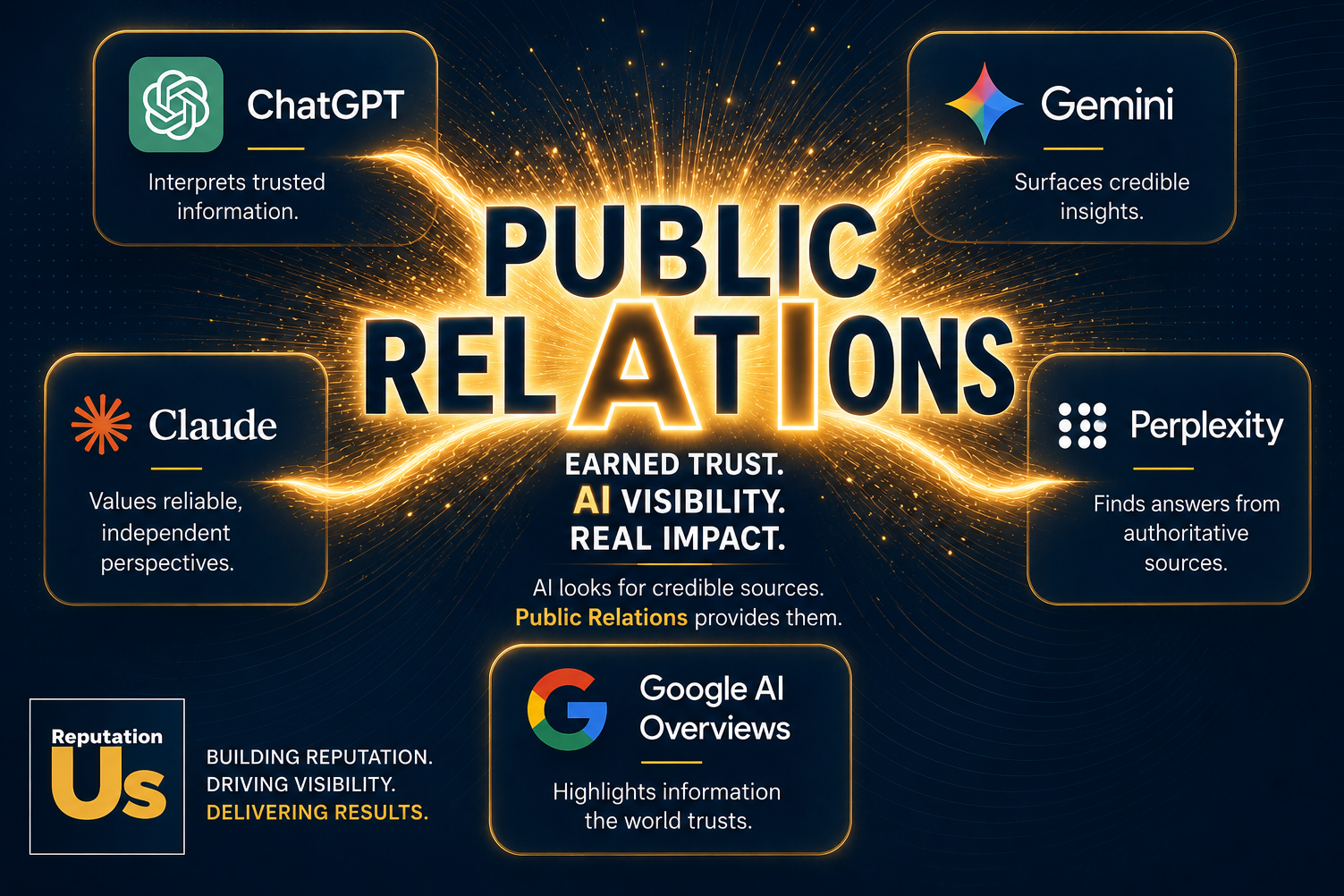
Large language models and AI search tools like ChatGPT, Gemini, Claude, Perplexity, and Google AI Overviews are not simply indexing what companies say about themselves. They are evaluating external validation signals, such as earned media coverage, third-party mentions, expert commentary, citations, research studies, podcasts, reviews, and authoritative thought leadership.
In many ways, AI is rewarding what strong public relations has always been designed to build: credibility.
Recent research strongly reinforces Gina Bonar’s point:
- Research highlighted by Worldcom Public Relations Group found that up to 90 percent of citations driving AI visibility come from earned media sources.
- Muck Rack analysis reported that approximately 84 percent of AI-cited links come directly from earned media and third-party sources rather than paid or owned content.
- Additional industry analysis from MacroLingo found that brands with stronger third-party mentions can receive dramatically more AI-generated references than brands relying primarily on their own websites.
That shift matters because search behavior itself is changing rapidly.
AI-generated answers are creating a “zero-click” environment where users increasingly receive summaries and recommendations without ever visiting a website directly. Recent reporting shows zero-click searches now account for nearly 70 percent of some search experiences.
Translation?
If your organization is not being referenced by credible external sources, AI systems may overlook you entirely, regardless of how polished your website is.
This is where reputation management and public relations intersect with AI readiness.
At ReputationUs, we increasingly advise clients that AI visibility is not just a technology issue. It’s a reputation issue.
Organizations that consistently earn (the following) are building what many now call “algorithmic trust:”
- Credible media coverage
- Executive thought leadership
- Expert commentary
- Independent validation and credibility
- Strong community reputation
- Message consistency
Trust influences whether AI systems surface your organization in recommendations, summaries, and decision-making moments.
RepUs is already seeing examples across industries:
- Healthcare organizations gaining AI visibility through physician expertise and research citations.
- Financial institutions (e.g., banks, credit unions, even fintech) being surfaced because of trusted third-party commentary and community credibility.
- Law firms, nonprofits, and public agencies earning stronger discoverability through consistent expert positioning and earned media presence.
- Police agencies, fire department ts and civic institutions (e.g., school districts) strengthening public trust through transparent communication and authoritative public engagement.
The organizations that will win in the AI era are not necessarily those producing the most content. They will be the organizations viewed as the most credible.
That is why PR, reputation management, and strategic communications are no longer “soft” functions sitting adjacent to business strategy.
They are becoming foundational visibility infrastructure for the AI economy.
Gina Bonar’s observation captures this moment perfectly: “AI systems don’t simply reward self-promotion. They reward earned trust.”
Public relations has always been in the trust business. Trust is now the most valuable of all commodities.